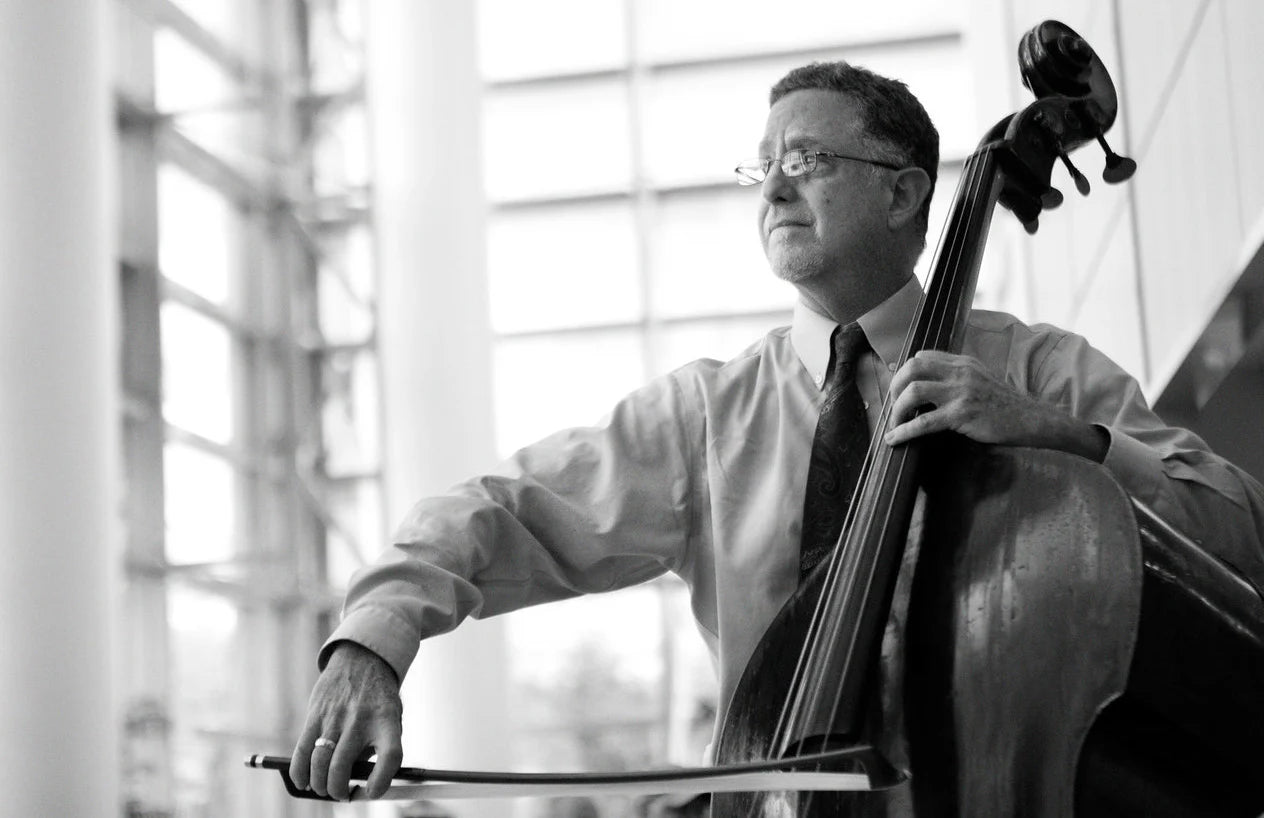



David Heyes
Arcady Dubensky: Valse-Fantasy for double bass & piano
Arcady Dubensky: Valse-Fantasy for double bass & piano
Couldn't load pickup availability
About the Composition
Valse-Fantasy is written in a tonal and traditional style, with late-Romantic influences and sensibilities, and its lively and dramatic waltz melody contrasts with a strongly independent and supportive piano accompaniment. Dubensky treats the double bass in a serious, lyrical manner and, although it doesn't push the boundaries in terms of technical or musical invention, Valse-Fantasy is idiomatic and a beautiful, accessible, and welcome addition to the intermediate repertoire.
Valse-Fantasy exploits the lyrical and sonorous qualities of the double bass in its orchestral register and was originally written for solo tuning. Rhythmically inventive and in a lyrical and melodic style, the extended introduction for piano alone (Allegro mistico) creates an atmospheric mood before the double bass weaves beautifully shaped melodies across the middle range of the instrument.
Dedicated A mon ami Fabius Coussevitzky [To my friend Fabien Sevitzky], Valse-Fantasy probably dates from Dubensky's final years in Russia, although no date is given and the piano copy is written on Russian manuscript paper.
Fabien Sevitzky (1893-1967) was the nephew of the great double bass virtuoso and conductor, Serge Koussevitsky (1874-1951) who changed his name when he moved to America in 1922. Sevitzky played double bass in the Moscow Imperial Theatre Orchestra, would have worked alongside Dubensky in the orchestra, and performed the Valse-Fantasy in Moscow, Warsaw, Vienna, Berlin and Philadelphia. In 1923 he joined the Philadelphia Orchestra as a double bassist but gradually became more well-known and respected throughout America as a conductor, often championing new works by Dubensky with his orchestra.
This edition includes accompaniments for both solo and orchestral tunings.
About the Composer
Arcady Dubensky was born in Viatka, Russia on 3 October 1890, into a musical family - his father was a dramatic Shakespearian actor and his mother was an opera and operetta singer - and he began to study the violin from the age of six. He became a member of the Viatka Cathedral Choir when he was eight years old and two years later made his concert debut at the Viatka City Theatre as part of the Cathedral Choir.
In 1904 he was offered a scholarship to study at the Moscow Conservatoire where he stayed until 1910, studying violin with Dulof (2 years) and Grijimali (4 years), alongside counterpoint with Alexandwr Illinsky. He subsequently studied in Switzerland with Cesar Thomson (violin) and in Paris with Alexander Glazunov (composition). After graduation he became a 1st violinist with the Moscow Imperial Opera Orchestra (1910-1919), at the same time taking conducting lessons from Arends, Director of the Ballet.
Dubensky left Russia in 1919 and worked for a time in Constantinople, arriving in America in July 1921. From 1921-22 he played first violin with the Capitol Orchestra (New York), and also with the New York Symphony Orchestra (1923-28) until its amalgamation with the New York Philharmonic Society in 1928. From that date until the mid-1950s he played as a second violinist with the New York Philharmonic, alongside his work as a talented and active composer-arranger.
Dubensky died at his home in Tenafly, New York in 1966, aged seventy-six.


