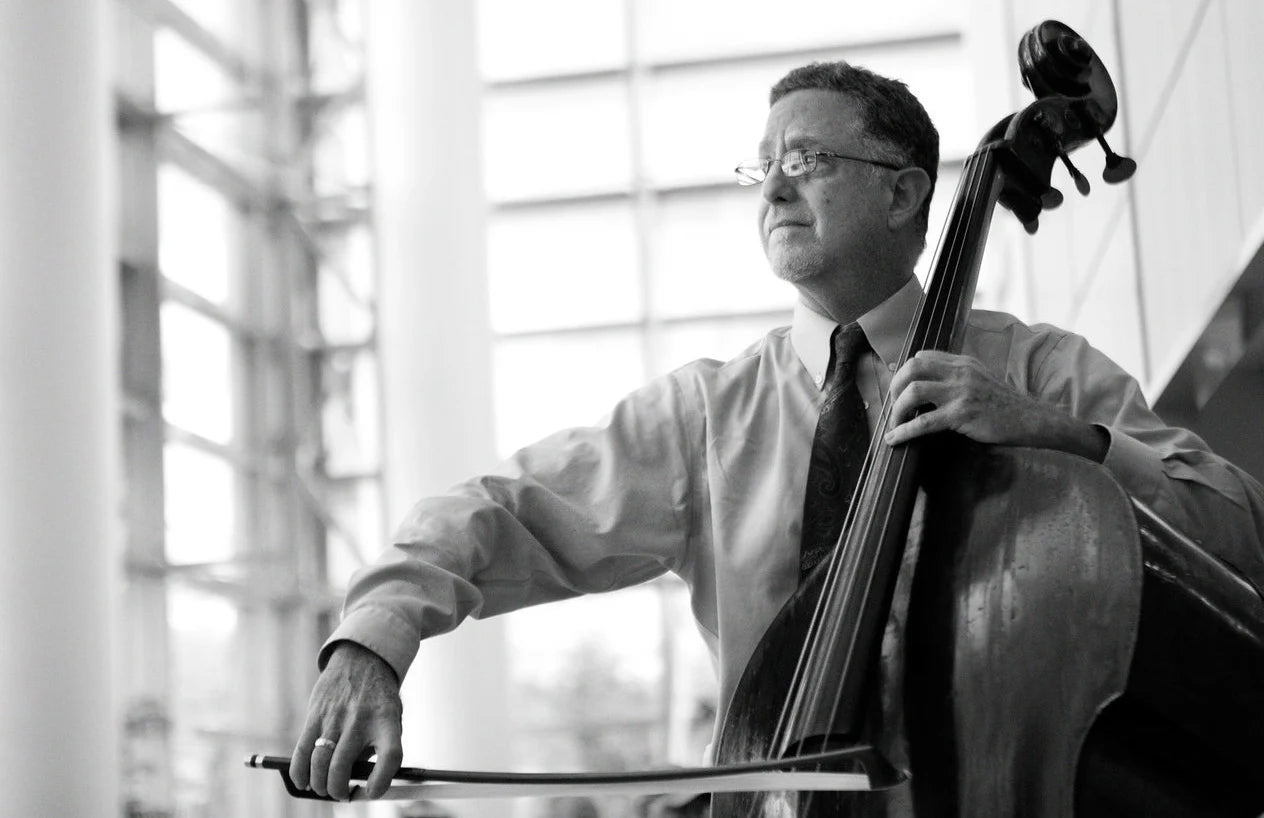



Mark Morton
Bottesini: Meditazione-Bach (Aria di Bach, "Air on the G String") for Double Bass and Piano (urtext ed. Mark Morton)
Bottesini: Meditazione-Bach (Aria di Bach, "Air on the G String") for Double Bass and Piano (urtext ed. Mark Morton)
Couldn't load pickup availability
What is an urtext edition?
What is an urtext edition?
An “urtext” edition is one that tries to remain as faithful to the original sources as practical, with little or no alterations, additions or omissions by the editor. This allows the interpreter to make his or her own technical and musical choices based on the “truth” of what the composer wrote – not someone else’s opinion of how a piece should be executed. (In traditionally edited editions, it is impossible to tell what is the composer’s notations, and what is an editorial alteration.) To the casual observer, an urtext edition may seem like a simple task of copying exactly what the composer wrote, and transcribing it into modern notation and typesetting. However, reality often presents challenges for the urtext editor, especially if there are legibility issues, inconsistencies, and more than one early source from the composer. Fortunately, Bottesini’s hand is remarkably clear, so there are only rare issues of legibility.
Based on the source manuscripts housed in the Bibliotheca Palatina in Parma, Italy, Bottesini typically wrote four different versions for almost every work: one with orchestral accompaniment, one with piano accompaniment, and both in two keys: one in solo tuning, and one in which the bass is tuned up a minor third higher than orchestral tuning. (I call this “minor 3rd” tuning.) With a number of exceptions, Bottesini was quite consistent between all four versions when it came to pitch and rhythm, but apparently placed little value on consistency of articulations or dynamics, perhaps reflecting on a spontaneous, almost improvisatory, approach to performance, and a realization that he was likely to be one of the few, if the only, soloist to perform these works.
It is my intent to create a practical urtext edition: one that remains faithful to the original, without over-burdening the interpreter with excessive notations and footnotes. When encountering inconsistencies between versions in either the solo part, or piano accompaniment, I applied the following criteria in choosing what to include (or not include):
1) The option that provides the most information
2) Options that are more interesting (elaborate)
3) Options that offer more contrast
4) The option that makes the most sense, often based on what is more physically executable
5) Remove redundancies
6) The option that matches analogous passages elsewhere in the piece
7) I do not include something that does not already exist somewhere in the sources. Any added editorial marking will be enclosed in parenthesis.
8) I refer to the orchestral score for insight into piano accompaniment and vice-versa
There are no solo bass parts in the Bibliotheca Palatina collection. Perhaps this is because Bottesini was the one of the only bassists to play these works, and being the composer, he did not feel the need to have a solo part for himself. The source for the solo bass part is the cues of the piano parts and orchestral scores, which are written in suono reale (an octave higher than traditional 16’ orchestral notation of double bass music.) In keeping with Bottesini’s notational style, the solo parts in these present editions are also in suono reale, a practice that offers many advantages over 16” notation: fewer clef changes, fewer leger lines, and no need for tenor clef.
About the Edition
An urtext edition of Giovanni Bottesini's (1821-1889) Meditazione-Bach (Aria di Bach) - which is in reality his arrangement of J.S. Bach's "Air on the G String" from the Orchestral Suite No. 3 for solo double bass and piano. This edition remains faithful to Bottesini's manuscripts housed in the Biblioteca Paletina, Parma, Italy.
This purchase includes a solo double bass part in suono reale (as was Bottesini's practice), and three piano parts: Orchestra Tuning, Solo Tuning, and minor 3rd Solo Tuning (as was Bottesini's practice). Orchestral parts are available for rent from Basso Pròfondo Publications.
Bottesini's arrangement of Bach's famous "Air on the G String" features a hauntingly beautiful, flowing melody that unfolds over a simple bass line in the piano. Serene and contemplative, the elegant melodic lines float effortlessly above the supporting harmony.
About the Editor
Mark Morton is the Professor of Double Bass at Texas Tech University. Dr. Morton is the first-prize winner of the 1990 International Society of Bassists Solo Competition held in New York City, and is the author of the popular “Dr. Morton” series of double bass technique books, and numerous articles in all important trade periodicals. For 23 years, he was a member of the Columbus (Ohio) Symphony Orchestra – 14 years as principal bass and 9 years as assistant principal bass. Additionally he is principal bass of the Lubbock Symphony and the Abilene Philharmonic.
A busy recitalist and concerto performer, Morton has soloed in Europe, South America, Central America, Taiwan, Canada, and the United States. He has been a featured double bass soloist on radio broadcasts including NPR's "Performance Today," WGBH in Boston, and WQXR in New York. His critically acclaimed Thresholds and Russian Rendezvous CDs, have become reference recordings of standard double bass repertoire. He also shares a CD with bassist Gary Karr of double bass music by Paul Ramsier. It was with that CD that Roger Dettmer of Classical CD Reviews proclaimed him as “a most artistic representative of the new generation developed in the last half century.”
Morton has played under the direction of many conductors including Leonard Bernstein, Lorin Maazel, Alexander Schneider, Hans Graf, Gunther Herbig, Vladimir Spivakov, Maxim Shostakovich, Gunther Schuller, Nicholas MacGeegan, Marvin Hamlisch, John Williams, Henry Mancini and Mitch Miller. Dr. Morton has twice appeared as the guest principal bass of the National Arts Centre Orchestra in Ottawa, Canada, Pinchas Zuckerman, Music Director. He has performed in Alice Tully and Avery Fischer Halls in Lincoln Center, the Kennedy Center in Washington, D.C., the Musikverein in Vienna, La Scala in Milan, and has appeared in Carnegie Hall, New York City over 30 times.
Morton has performed on stage with many pop artists including: Dizzie Gillespie, Dave Brubeck, James Taylor, The Beach Boys (twice), Brian Wilson, Three Dog Night, Doc Severinson, The Eagles, Jose Feliciano, Marilyn McCoo, Peter, Paul & Mary, Luciano Pavorotti (twice), Judy Collins (twice), The Smothers Brothers, Marichi Cobre, Ricky Scaggs and Kentucky Thunder, Asleep at the Wheel, Boyz2 Men, and many others.
Additionally, Mark Morton is an accomplished pianist, having appeared as piano concerto soloist with several orchestras, including the Houston Symphony Orchestra. His recent release on Albany Records, Bottesini Greatest Hits features Morton accompanying himself on piano, for which American Record Review says, “Mark Morton is a fine player on both instruments, and the music is lovely…” Fanfare commented, “His intonation is fine, and he certainly handles the bravura passages well.”
Formerly, Dr. Morton was instructor of double bass at Capital University, and Ohio Wesleyan University, and was the assistant double bass instructor for Gary Karr at the Hartt School of Music in Hartford, Connecticut.He has taught at summer festivals in the US, Canada, France, Belgium, and Costa Rica.
The DrMarkMorton YouTube Channel is a go-to reference for TMEA All-State audition demonstrations, excerpts, etudes and solos, and even a number of Beatle covers, for which the Arizona Republic described Morton as “an accomplished musician who sounds like a cross between Lennon and McCartney.” The DrMarkMorton YouTube Channel and has garnered more than 7400 subscribers and over 1.5 million views.
Dr. Morton earned the undergraduate and graduate degrees from the Juilliard School in New York, being only the second bassist to earn the Artist Diploma, Bachelor, Master and Doctor of Musical Arts degrees all from Juilliard. While there, he was a member of the first historically informed performance group at Juilliard - the Juilliard Chamber Orchestra - under the direction harpsichordist Albert Fuller. The JCO performed a 13 city, 10 country tour of South America in summer 1983. Morton was also a member of the Bach Players, a student formed ensemble that performed all the major orchestral works of J.S. Bach. His principal teachers include David Walter, Channing Robbins, Stuart Sankey, Eugene Levinson and Winston Budrow.


