


David Heyes
Max Dauthage: 20 Melodic Pieces Book 4 for double bass & piano
Max Dauthage: 20 Melodic Pieces Book 4 for double bass & piano
Couldn't load pickup availability
About the Book
20 Melodic Pieces was first published in Vienna and Leipzig in 1911 and offers excellent teaching and recital repertoire for the good intermediate bassist, combining musical and technical challenges in equal measure. The accompaniments are interesting and supportive, complementing inventive, lyrical, and dramatic solo lines for the double bass, written in a lyrical, late-romantic style.
Book 4 includes five colourful and engaging pieces, primarily in the orchestral register but also venturing into thumb position.
Table of Contents
16. Humoresque is marked Gemessen, which means measured, dignified, or restrained, and is rhythmically interesting throughout. The opening theme has a capricious and sprightly Viennese character, making use of the middle register of the double bass, supported by a simple and colourful accompaniment. A pizzicato section adds contrast and interest before the opening theme returns and develops into a playful coda, with a bright and effective ending.
17. Concert Study is an extended piece with scale and arpeggio figures which create constant energy and movement, and is effective as both a recital piece and a technical workout for the bassist. Written in the style of a moto perpetuo, a chordal and static accompaniment adds wonderful stability, underpinning music which will test the musical and technical skills of the soloist.
18. Valse Triste is elegant and stylish, remembering a past age and emphasising the lyrical and sonorous qualities of the double bass. The middle section and sudden change of key produce music of a dramatic and darker hue before a brief repeat of an earlier phrase brings the piece to a bright and successful conclusion.
19. Dance is a fast and lively moto perpetuo, brimming with technical challenges alongside a contrasting middle section with an emphasis on upwardly moving arpeggio figures, mostly in bass clef. It has a powerful energy and momentum, creating music which is ideal for both study and recital purposes. The accompaniment is effective and supportive with an occasional rhythmic flourish which adds colour and drama and Dance ends in a simple and understated way.
20. Concert Waltz begins with a brief recitative-like introduction before the waltz music begins and the soloist is able to sing wonderfully evocative melodies, mostly in the solo register of the double bass. The accompaniment is always supportive, typical of the waltz style in general, and a number of mood changes create added interest and variety. This is salon music at its very best and brings an old-world charm and elegance to the final piece in this wonderful series.
This edition includes accompaniments for both solo and orchestral tuning.
Added Bonus
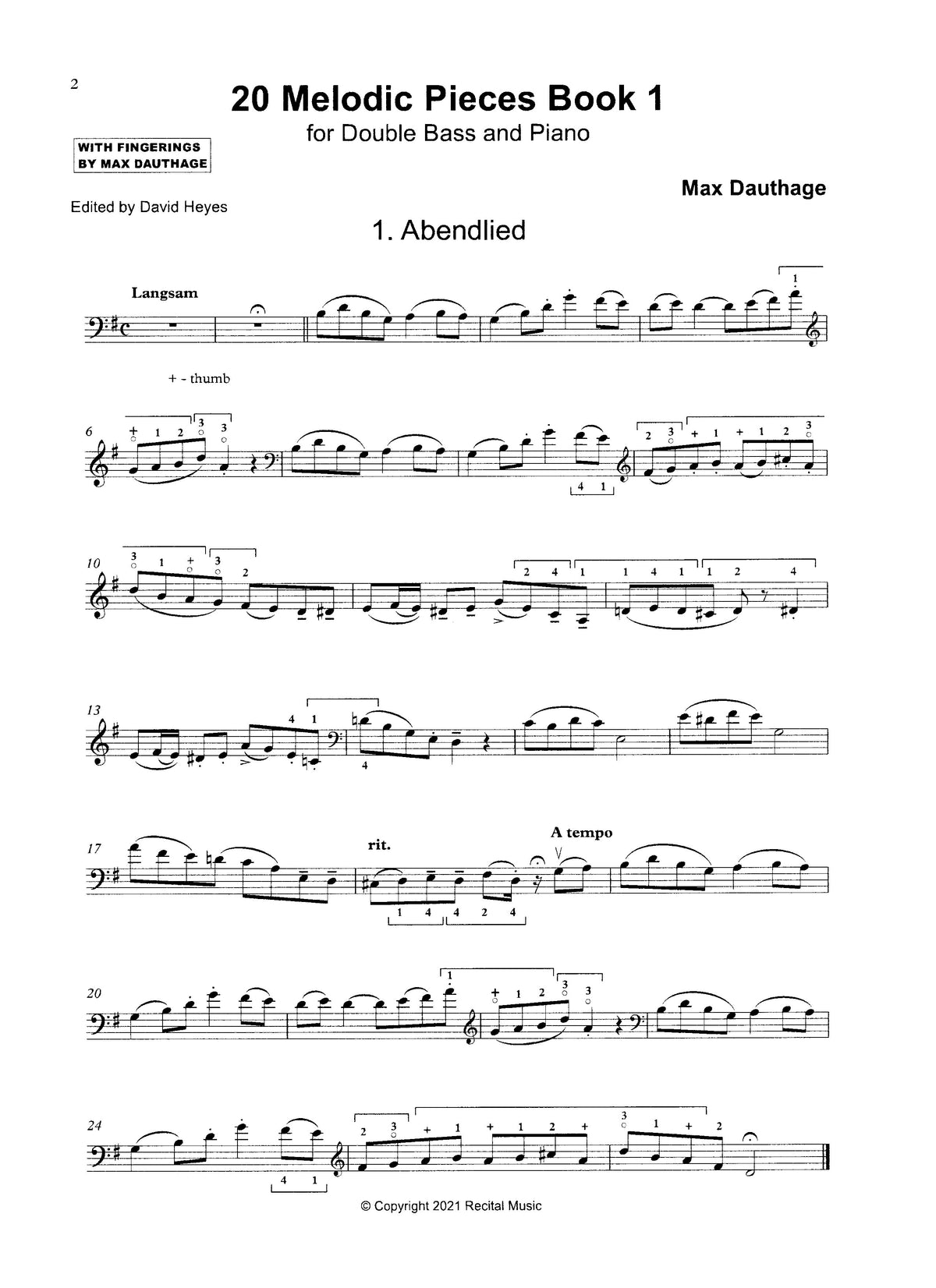
Book 4 also includes copies of the pieces with original fingerings by Max Dauthage.
About the Composer
Austrian bassist-composer Max Dauthage (1862-1937) studied at the Vienna Conservatoire with František [Franz] Simandl. He completed his studies in 1884 and joined the Vienna Philharmonic Orchestra, where he played until his retirement in 1918. Dauthage taught at the Vienna Conservatoire from 1910-31 and composed a number of recital and educational works for the double bass, including 20 Melodische Übungsstücke [20 Melodic Pieces], A School of Virtuosity, Concerto, Andante & Humoresque, and Andante (4Db), amongst others.