


David Heyes
David Heyes: Advanced Daily Exercises for Double Bass
David Heyes: Advanced Daily Exercises for Double Bass
Couldn't load pickup availability
About the Exercises
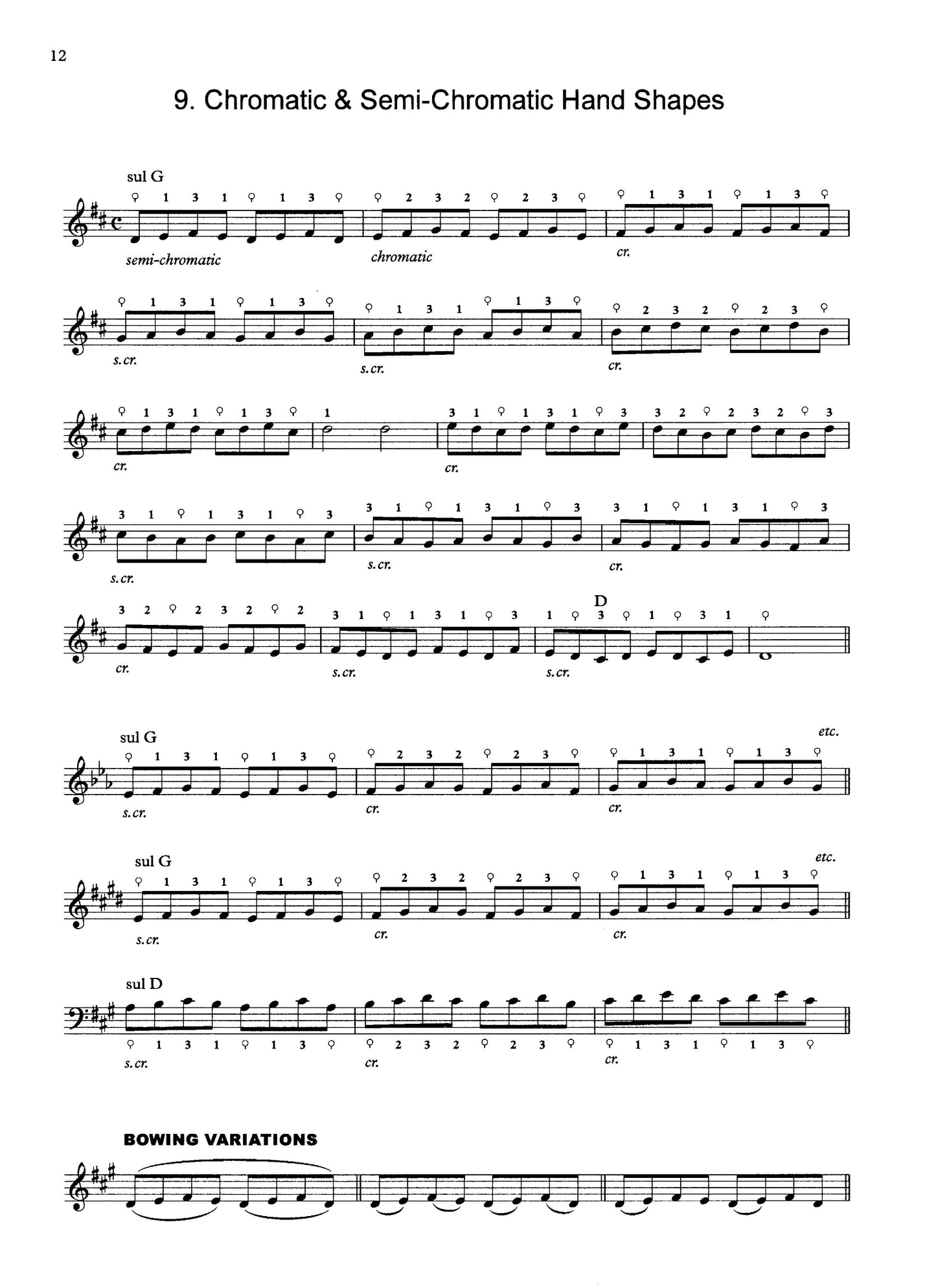
Advanced Daily Exercises, first published in 2013 and revised in 2026, takes the bassist into the higher register of the double bass, with exercises moving slowly and progressively from bass clef to treble, alongside studies in thumb position. Each of the twelve exercises is designed to build a confident technical command of the double bass, with an emphasis on scale and arpeggio passage work, including handshapes in all registers alongside simple shifts.
Scales and etudes will complement the technical challenges encountered in each exercise, which can be studied in any order to best suit the bassist, student or teacher. Players are encouraged to use the exercises as the starting point for their journey into the solo register and a range of different dynamics, articulations and bow strokes can be introduced to vary the challenges and skills in each.
Bow Placement
A simple approach to bowing is to imagine five different bow placements where point 1 is at the end of the fingerboard and point 5 is towards the bridge. Points 1 & 2 are close to the end of the fingerboard and are ideal for quieter passages and diminuendos. The bow speed is faster and this area is perfect for creating subtle colours and timbres and for more delicate music. Point 3 is midway between the end of the fingerboard and the bridge. The bow speed is slower than 1 & 2 and 3 will always produce a good sound. Point 3 should be your default setting and you will quickly recognise the strong tone colours in this area of the string. Points 4 & 5 are closer to the bridge, with much slower bow speeds, and are perfect for a louder and more projecting tone. Aim to play the exercises with the bow at point 3 and remember to change to 4 or 5 as you move into thumb position and the higher register, and as the string length shortens.
Table of Contents
1) Scale Patterns
2) Chromatic Handshapes & Shifts
3) Thumb Position: Chromatic Handshape
4) Chromatic Progressions into Thumb Position
5) Running Thirds
6) Thumb Position: Semi-Chromatic Handshape
7) Scales in Thirds
8) Thumb Position: Diatonic Handshape
9) Chromatic & Semi-Chromatic Handshapes
10) Scale Patterns, Arpeggios & Double Stops
11) Thumb Position: Scales & Arpeggios
12) Chromatic Forward Shifts: Perpetuum Mobile by Gustav Láska
About David Heyes
David Heyes studied double bass with Laurence Gray and Bronwen Naish, later at the Royal College of Music in London, and completed his post-graduate studies in Prague with František Pošta (Principal Bass, Czech Philharmonic Orchestra). He has given recitals and masterclasses in 20 countries over the past few years and has been a juror at a number of international competitions, three times as chairman. David's collaborative work gained him a prestigious award from the David Walter Charitable Trust of New York for his pioneering activities as a soloist, teacher, publisher, and commissioner of new music for double bass, and he works with composers throughout the world to expand the double bass repertoire by commissioning new music and by rediscovering forgotten ones.
Since 1983, more than 700 works have been written for him, music from one to twenty basses and from beginner to virtuoso, and he has premiered ten contemporary concertos with orchestra. David began to compose in 2013 and has had music performed and recorded in 36 countries across five continents. He is a D'Addario Performing Artist and has recently commissioned a solo double bass from British master-luthier Martin Penning.