


David Heyes
Frantisek Simandl: Fantasia on Bohemian National Songs Op.32 for double bass & piano (ed. David Heyes)
Frantisek Simandl: Fantasia on Bohemian National Songs Op.32 for double bass & piano (ed. David Heyes)
Couldn't load pickup availability
About the Composition
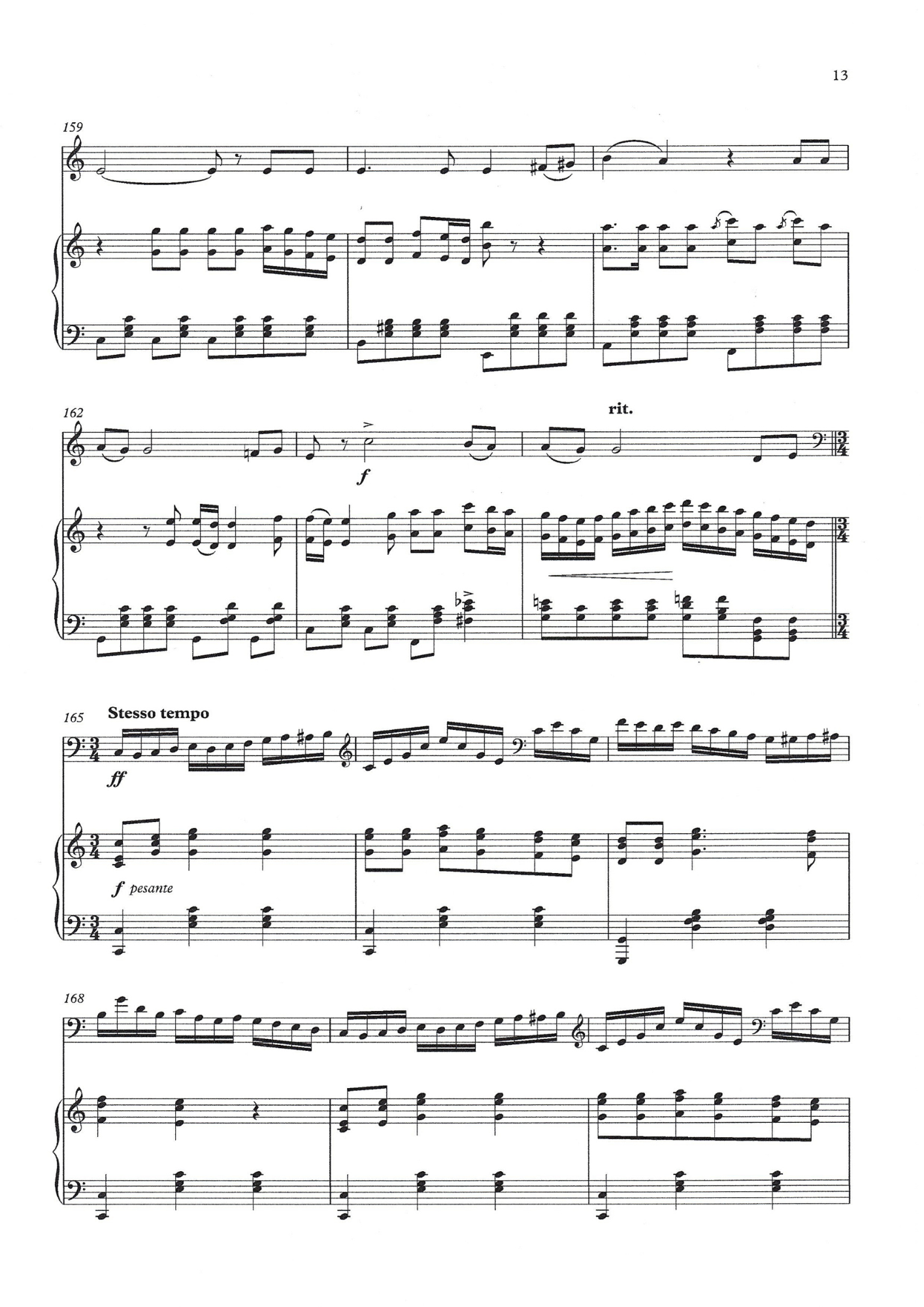
Fantasia on Bohemian National Songs is a spirited and engaging work which is ideal for the intermediate bassist. It utilizes much of the range of the solo double bass, offering technical and musical challenges in equal measure, alongside a colorful and inventive piano accompaniment which adds support and rhythmic interest.
First published in Vienna in 1886, Fantasia on Bohemian National Songs is in one extended movement, with a number of connected sections which add contrast, drama and interest, in music which is instantly appealing and accessible. Simandl writes in a confident and charming late 19th-century style, and this would be ideal as the opening or closing piece in a recital.
This edition includes piano accompaniments for both solo and orchestral tuning.
About the Composer
František [Franz in German] Simandl was born in Blatná (Bohemia) on 1 August 1840, the son of a folk musician. At the age of eleven he had the good fortune to be taken under the wing of Josef Martinovský, a teacher of exceptional musical experience who joined the staff of the local music school in 1851. Martinovský taught Simandl to sing and play the violin and it was also thanks to his teaching skills that the young Simandl managed to secure a place at the Prague Conservatoire. When he left there in July 1860 he had not only a graduation certificate signed by Professor Josef Hrabě (1816-1870), but also examination results for military Kapelle playing. He went on to spend eight years playing under Stastný, and the elder Komzák, in the Kapelle of the 11th Infantry Regiment stationed successively in Písek, Vincenza, Padua, Trieste and Lina, where he also did freelance double bass work and even played trombone in the theatre orchestra.
In 1869 Simandl won the position of Solo Double Bass of Vienna's Imperial Opera, playing with them for thirty-five seasons. He was simultaneously a member of the Vienna Philharmonic Orchestra, Hofkapelle and from 1876, played Principal Bass in Bayreuth's famous Wagner Festivals. From time to time he also played in chamber music, including performances with the Hellmesberger, Kretschmann and Lidový quartets and frequently played the double bass part in the Piano Quintet in E minor Op.3 by Josef Labor (1842-1924) - a work dedicated to Simandl by the composer.
Simandl composed many songs, his favourite genre, choral works, a Pastoral Mass, made arrangements for military band and wrote many works for double bass, but is chiefly remembered for his educational and instructional music for double bass, which remains in print to this day. His Method for Double Bass was written for the Vienna Conservatoire, where he was Professor of Double Bass, and was first published in Vienna in 1874/5 and is still in print, now available in a number of editions and various languages.
As a player, Simandl was renowned for his outstanding technique, using a new approach to thumb position, and producing a sound which was both powerful and lyrical. He was regarded as a brilliant orchestral player and a much admired soloist and chamber musician in Vienna, and was one of the finest double bassists of his generation, also responsible for a whole generation of bassists who exported his style of playing and teaching to almost every corner of the world. As a soloist Simandl was most active in the Austrian capital and surrounding countries, often accompanied by the pianist-composer Bretislav Lvovský, who composed a number of works for double bass.
Lvovský made an interesting comparison between Simandl and Bottesini: "Some concert-goers preferred Bottesini because he used a so-called salon double bass with thin strings, whereas Simandl employed a traditionally built instrument (from 1893, on a majestic Maggini double bass) with normal strings. Specialists who have had the chance to hear both virtuosi in the same pieces give the edge to Simandl for strength and quality of tone as well as for his superb technique."
To the large number of Czech's living in Vienna Simandl was equally regarded as a double bassist, conductor, choirmaster, singer and ever-willing organizer of cultural events. He belonged to the Vienna branch of the Slovanská Beseda (Cultural Society) from 1874, conducting their concerts for over 25 years and in 1891 was appointed President and Artistic Director of the society. Though forever abroad he remained a loyal Czech and for many years was in charge of the Vienna Philharmonic, being largely responsible for the promotion of Czech music with the orchestra, including symphonic works by Smetana, Dvořák and Fibich.
František Simandl died in Vienna on 13 December 1912, after a long and protracted illness, and shortly afterwards the violin teacher, Jan Hrímalý wrote a letter to his friend's home town: "I trust that with your kind help Blatná will not, in times to come, forget its most widely known son whose teaching manuals and compositions have marked a new epoch in their field!"
Frantisek Simandl was one of the key figures of the Prague School of Double Bass and his Method and books of studies marked a turning point in double bass teaching. He standardized much of the basic technique that we still use today and helped to increase the solo repertoire as a composer, transcriber and editor. The third part of his Method [Advanced Course for the Double-Bass], first published in Germany in 1903 by C.F.Schmidt (Heilbronn), consists of 50 recital works divided into nine volumes. 49 pieces are for double bass and piano (7 transcriptions and 42 original works) and one is for double bass trio - Verrimst's Au Clair de la Lune. 14 works were composed by Simandl and the others were collected by him from many leading player-composers active in Europe at the end of the 19th-century. [David Heyes]