


David Heyes
Luigi Boccherini: Sonata No.9 in F major for double bass & cello
Luigi Boccherini: Sonata No.9 in F major for double bass & cello
Couldn't load pickup availability
About the Composition
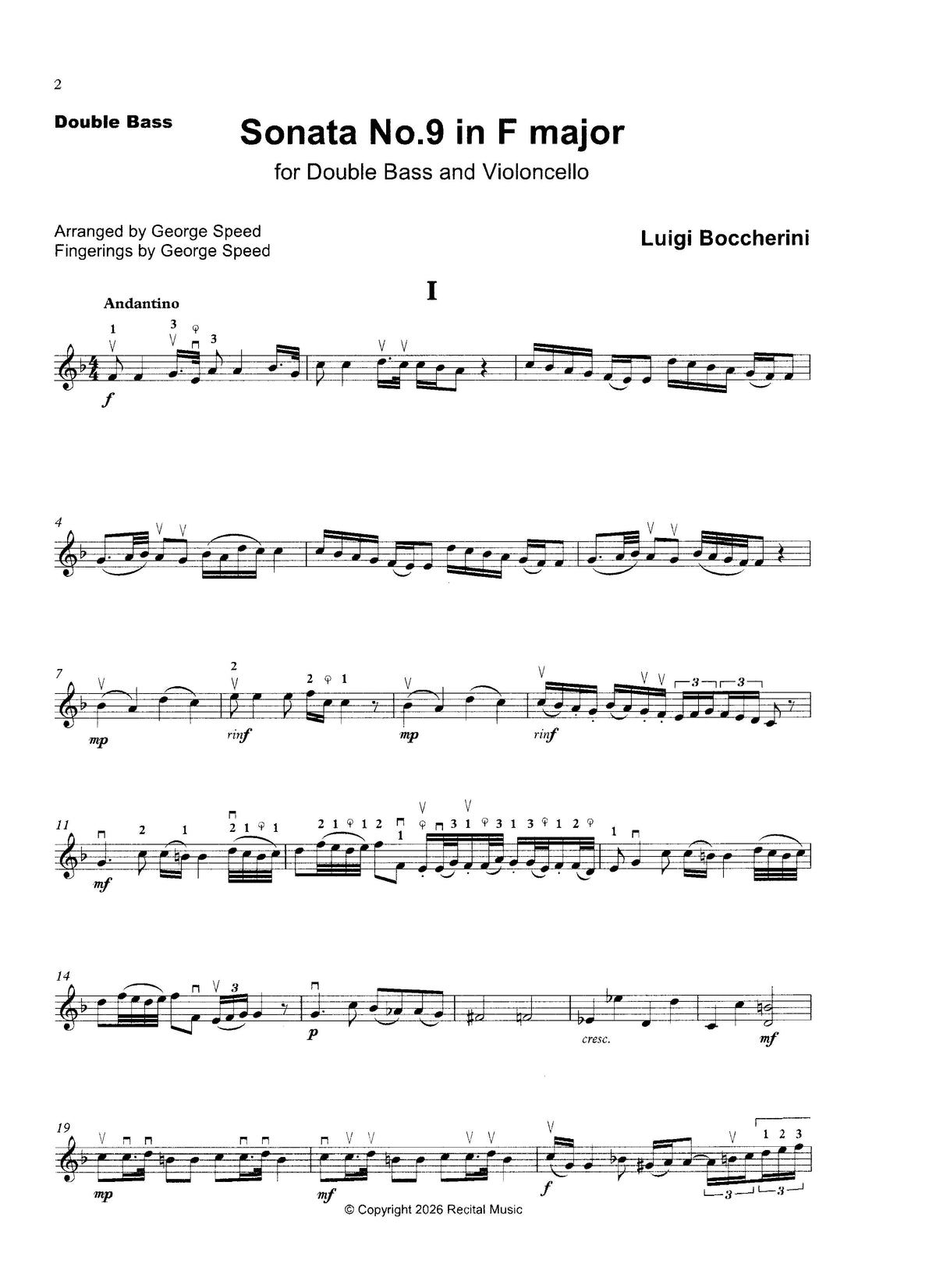
This new edition of Boccherini’s Sonata No.9 in F major has been beautifully and sympathetically arranged for solo double bass and violoncello by American bassist George Speed. Originally for two cellos, the three movements emphasize the lyrical and sonorous qualities of the double bass, particularly in its upper register, with many musical and technical challenges. The first two movements are graceful, elegant and expressive, contrasting the final movement, which is dance-inspired, reflecting the refined galante style of the age.
The edition includes a score and two parts in orchestral tuning, alongside another cello part in G major if the bassist prefers to play in solo tuning. There are two double bass parts, one which is clean, and one with suggested fingerings by George Speed.
A Note From the Arranger
I first learned this charming sonata in college. Like my admiration for the Vivaldi sonatas (which I transcribed in 2018), my interest in this piece originated from a recital I heard Edgar Meyer play in the early 1990s. I have since performed it numerous times, also recording it on an album of classical era solos back in 2022. Like Edgar, I have almost always played it with piano, but several years ago I performed the first movement with my good friend and fellow bassist Anthony Stoops providing the accompaniment. I enjoyed the simplicity of that texture, plus the purist in me appreciated that we were adhering more closely to Boccherini’s original vision: solo instrument with a bass line (non-keyboard) accompaniment.
The original piece is in a rather high tessitura, as is typical of Boccherini’s virtuoso cello works. As such, it works nicely a full octave below original cello pitch, without sounding too muddy or dark. I play the pitches as they appear in the original (F major) version, with only slight modifications, so the sounding key in solo scordatura is G major. Playing the piece in solo tuning is my personal preference, but it also works nicely in orchestral tuning. Most of the melodic writing is in our vocal register and lower thumb position, only once going as high as the G above middle C.
I’m pleased finally to create an edition for either 2 basses or bass with cello accompaniment. I hope it encourages others to explore this beautiful sonata.
George Speed
August 2016