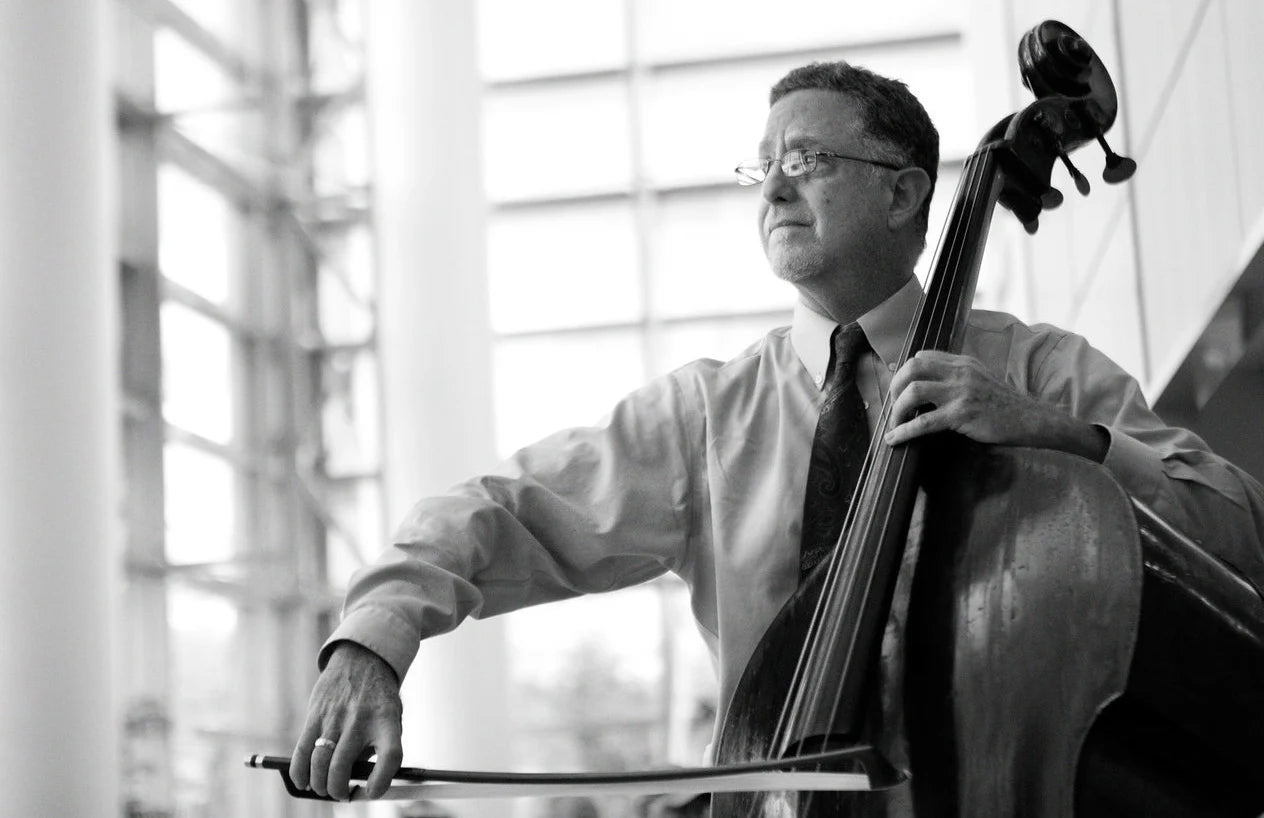



David Heyes
Teppo Hauta-aho: Typically Teppo 4 for unaccompanied double bass
Teppo Hauta-aho: Typically Teppo 4 for unaccompanied double bass
Couldn't load pickup availability
About the Composition
Typically Teppo 4 brings together four engaging and amazingly inventive pieces which demonstrate the many musical and technical possibilities of the solo double bass, each in celebration of a great double bassist. All were composed in the 21st-century with each inhabiting its own individual and unique musical soundscape. Teppo Hauta-aho was a past master at creating evocative and imaginative musical soundscapes which utilised many modern playing techniques alongside embracing a wealth of musical styles and idioms.
Table of Contents
1. Ode to Rabbath An evocative and mesmeric solo for unaccompanied double bass which brings together two giants of the double bass world - Teppo Hauta-aho and François Rabbath. It utilises the entire range of the double bass, with its insistent drone grounding the piece and contrasting the extreme ranges of the instrument. 'Ode to Rabbath' is a work of great creativity, musicality and inspiration. There are musical and technical challenges in equal measure and much to explore for the advanced and enterprising bassist.
2. The Last Summer Composed in 2014 to commemorate the 95th anniversary of František Pošta's birth, this evocative and atmospheric one-movement work reflects the composers worries and concerns during the summer of 1991 and is based on material from Hommage à František Pošta, a duet for 2 double basses.
Teppo Hauta-aho studied with František Pošta (1919-1991) in Prague in the 1960s, when Professor Pošta was the revered and much respected Principal Bass of the Czech Philharmonic Orchestra, and had maintained a strong friendship and bond for the next 25 years. In 1991, František Pošta's health was beginning to decline, and the piece reflects his plans to visit Finland again, having performed and taught there for many years. Would he be well enough? At one point the answer was yes, then no, then yes... Unfortunately, František Pošta was never to visit Finland again and died in Prague in August 1991.
The Last Summer captures the unsettled nature of that final summer, the hopes and concerns for a much-loved bassist and friend. The music is typical of Teppo Hauta-aho's work and employs a wealth of textures, timbres and techniques to create a unique work of beauty and style. The music explores a range of colours and there is scope to create huge sweeping panoramas of sound and vision within a short space of time. The Last Summer was written for David Heyes, who studied with František Pošta in the late 1980s, and was premiered by David at Village Hall (Templecombe, Somerset, UK) on 16 August 2014.
3. Poetic Caprice Poetic Caprice is dedicated to François Rabbath and all open-minded bassists and is a tour-de-force for the solo bassist. This is an inventive and constantly evolving bowing and string-crossing study, offering musical and technical challenges for any adventurous bassist looking for something a little different. Employing both arco and pizzicato across much of the solo register of the instrument, this is a piece which is instantly engaging and evocative. There are two versions of bars 149-160 and this new digital edition includes both - the player can choose. Poetic Caprice has been recorded on Secret Memories (Simax PSC1324) by Dan Styffe (double bass).
4. Questions & Answers Written in January 2003 as a tribute to jazz legend, Ray Brown, this impressive and evocative work is played pizzicato throughout and the musical material is based on the letters of Ray Brown's name. In one movement, there is much here to explore and enjoy for the classical or jazz bassist.
Questions - the first part (rubato) is fairly relaxed and rhapsodic, with snatches of pizzicato jazz lines continually interrupted by sustained harp-like chords. Answers - begins at bar 33 (medium fast) and contrasts the opening section with music of a more metronomical and rhythmic style, typical of the strong and steady time keeping style of Ray Brown. It explores a number of pizzicato techniques and sounds, and offers opportunities for expressive and musical interpretation.
About the Composer
Finnish composer and bassist Teppo Hauta-aho was the most prolific bass composer of our time and since the 1970s has composed more than 400 works for double bass - spanning the entire range of standards from beginner to virtuoso.
Teppo Hauta-aho was born in 1941 and studied double bass with Orvo Hyle and Oiva Nummelin in Finland, and František Pošta in Prague. He played with the Helsinki Philharmonic between 1965 and 1972, and the Finnish Opera Orchestra from 1975 to 2000. Teppo Hauta-aho was an active recitalist, both classical and jazz, gave more than 300 recitals with his duo partner, Carita Holmström, and was at the cutting edge of modern improvisation - performing with leading improvisers throughout the world, for many years.
Finnish composer Harry Wessman writes: "As a composer, Teppo Hauta-aho has always been his own teacher, basing his technical knowledge on his wide practical musicianship as an orchestral player, chamber and jazz musician. It would not be an exaggeration to claim that he was the jazz bassist most in demand in Finland in the 1970s, and a few of his works are pure jazz compositions. But the compositional techniques and musical means used in the majority of his works originate in an unusual openness for any devices. Along with modern techniques, his source of inspiration includes all the previous stylistic periods in European music, impulses from Oriental music and, of course, jazz. His own instrument, the double bass, has profited especially from his rich inventiveness in finding new means to conjure forth unusual sounds from the instrument, and in applying them in an artistically meaningful and striking way."
Teppo Hauta-aho's music has been performed extensively in Finland and abroad, notably in America, Britain, Germany, France, Czech Republic, Soviet Union, Australia and Switzerland. He died in Helsinki on 27 November 2021.


